


A Hallmark on Cork's Skyline

The story of R. & H. Hall, from its nineteenth-century beginnings to the iconic grain silos of Kennedy Quay.
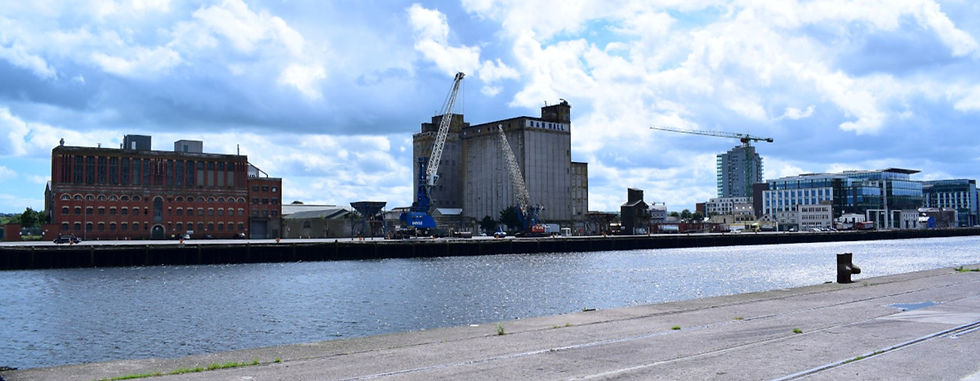
Cork city's skyline was transformed at the end of February 2024 with the demolition of the R. & H. Hall grain silos. The facility had dominated views of the city since July 1936, when building contractors John Sisk & Son Limited completed construction of the National Grain Silo on Victoria Quay (now Kennedy Quay).
The earliest records of R. & H. Hall suggest that the business originated with Cork merchant Frederick Hall, who operated an import business with his son Robert. Another son, Henry, subsequently joined the business and, according to the Cork Southern Reporter, Robert and Henry Hall were importing sugar from Jamaica, as well as tea and coffee, by July 1840.
The second half of the nineteenth century was a period of both difficulty and progress for the Hall family and their business. Frederick Hall died in July 1856, followed by his son Henry in July 1863, leaving Robert Hall (1810–1892) to continue the business. His son, Robert Constable Hall (1836–1888), subsequently joined the enterprise, becoming a senior partner and contributing to its expansion.
Following the death of Robert Constable Hall in 1888, the business passed to his son, Robert Hall (1866–1926). R. & H. Hall was incorporated as a public company on 6 April 1889, with the younger Robert eventually becoming Chairman of Directors, a position he held until he died in 1926.

This generation of the Hall family had strong connections with Glanmire. Robert junior married Isobel Travers Forrest on 21 July 1888 in Kensington, and the couple subsequently settled at Glenmervyn. Described as 'a long 2 storey … house with gables and bargeboards … and an iron veranda', the residence was built on the site of an earlier big house, Janemount. Its castellated entrance gate can still be seen between the grotto in Glanmire and the village. The 1901 Census records Robert and Isobel Hall living at Glenmervyn with their four children: Geraldine Marjorie, Robert Aylmer, Gerald Percy and Ian Mervyn. Robert's occupation is recorded as Justice of the Peace for the Borough of Cork and corn merchant.
On 14 July 1925, Isobel Travers Hall died and was buried at St Lappan's, Little Island. Seven months later, her husband Robert also died. The Evening Echo reported that the eldest son of Robert Constable Hall of Rockcliffe, Blackrock, was one of the principals of R. & H. Hall. He had also served as a member of the Cork Harbour Commissioners and was president of the Church of Ireland Young Men's Association. An enthusiastic yachtsman, his vessel, Marigold, was well known in Cork waters.

His funeral service took place at St Mary's Church, Glanmire, after which the cortège proceeded to Little Island, where he was laid to rest beside his wife. His passing was acknowledged by numerous organisations, including Sarsfield Hurling Club and the Cork Harbour Board. The latter paid tribute to him as 'a gentleman of charming personality and manner … as a business man he was not merely a successful man but also a man of inflexible integrity and uprightness.'
The family legacy continued with Robert Aylmer Hall (1891–1963), son of Robert Hall (1866–1926) and Isobel Travers Hall. Born in Glanmire, he went on to become Chairman of R. & H. Hall. In 1934, he was appointed a director of National Grain Silo Limited, a company established by R. & H. Hall and J. W. Green.
A year later, construction began on the new grain silos at Kennedy Quay. The business continued to prosper, and although Robert Aylmer Hall died on 21 June 1963, the family connection endured. By 1967, the company's directors included Henry Mitchell Hall and Robert Cecil Aylmer Hall, both direct descendants of Frederick Hall, the founder of the business in the early nineteenth century.
In 1990, R. & H. Hall was acquired by the Irish Agricultural Wholesale Society (IAWS), and the business continues to trade today.
The demolition of the grain silos in February 2024 marked the end of a familiar chapter in Cork's industrial and maritime history. For almost 88 years, the imposing structures had been a defining feature of the city's skyline, representing a business whose origins stretched back to the nineteenth-century import trade.
Yet the story of R. & H. Hall is about more than grain and silos. It is also the story of a family whose commercial interests became deeply intertwined with Cork's development, and whose connections extended into the community of Glanmire. As the Cork Docklands undergoes its transformation, there is hope that some of the machinery salvaged from the former R. & H. Hall buildings may yet find a new home as a sculptural feature on the quayside. Such a fitting reminder would ensure that, although the silos have disappeared, their place in Cork's history is not forgotten.


Comments